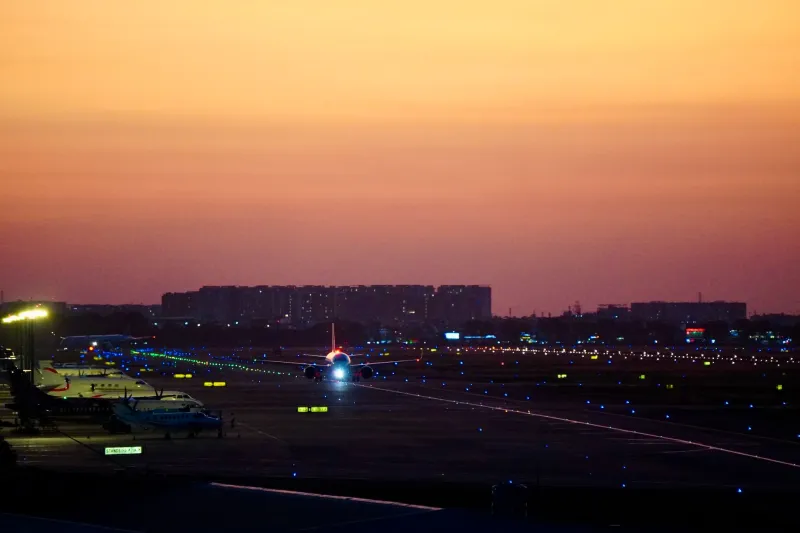
When the Skies Over India Turn Against You: Navigating Monsoon Season on the India-US Route

For millions of US-based Indian travelers, the summer months carry an almost gravitational pull toward the subcontinent. School vacations align. Family reunions beckon. Weddings fill the calendar. The India-US route sees some of its highest demand between June and September — which is, by no small coincidence, precisely the period when the Indian monsoon is at its most disruptive. What many travelers discover only after booking is that flying into or out of India during this window involves a calculated gamble, one where the stakes extend far beyond a delayed departure.
What the Monsoon Actually Does to Aviation
The Indian monsoon is not a single weather event. It is a seasonal atmospheric shift that sweeps northward from Kerala in early June, progressively engulfing the subcontinent over a period of weeks before reaching the Himalayan foothills by July. At its core, this phenomenon involves moisture-laden winds from the Arabian Sea and Bay of Bengal colliding with the landmass, generating sustained periods of heavy rainfall, low visibility, and severe convective activity.
For commercial aviation, convective activity — the kind that produces towering cumulonimbus clouds capable of reaching 50,000 feet — is among the most serious operational hazards in existence. Aircraft cannot safely penetrate these formations. Pilots and dispatchers must route around them, which lengthens flight paths, increases fuel burn, and compresses arrival windows at already congested airports. Mumbai's Chhatrapati Shivaji Maharaj International Airport and Chennai International Airport, two of the busiest gateways for India-US traffic, sit directly in the path of monsoon systems that arrive with particular intensity.
Visibility drops during heavy rainfall can push conditions below instrument landing system minimums, forcing aircraft to hold in stacking patterns, divert to alternate airports, or return to their origin. A single wave of disruption at one hub can propagate across an entire airline's network within hours, affecting connecting flights in Dubai, London, Frankfurt, and ultimately New York, Chicago, or Los Angeles.
The Cascade Effect: How One Storm Ripples Across an Itinerary
Consider a traveler flying from Chicago O'Hare to Mumbai with a connection in London. A severe convective band over the Konkan coast delays the London-Mumbai sector by four hours. The aircraft that was supposed to operate the return Mumbai-London leg is now sitting on the wrong side of the Atlantic. Crew rest requirements kick in. The London-Mumbai flight the following morning is now delayed as well, which affects a separate set of passengers who have connecting flights to the US. Ground staff at Heathrow are fielding rebooking requests from two disrupted flights simultaneously.
This cascade effect is not hypothetical. Aviation operations data consistently shows that monsoon-related disruptions at Indian hub airports generate secondary delays across Gulf carrier hubs — particularly Dubai, Abu Dhabi, and Doha — which serve as the primary connecting points for the majority of India-US traffic. A ground stop at Mumbai can, within 24 hours, manifest as a missed connection in Dubai for a traveler who boarded in Houston.
The Financial Arithmetic of a Monsoon Disruption
The direct costs of a weather-related disruption during monsoon season can surprise even experienced travelers. Airlines are generally not obligated to provide compensation for delays classified as extraordinary circumstances — a category that typically includes weather events. Depending on the carrier and the specific fare class, a traveler may find themselves responsible for their own hotel accommodation during an extended delay, particularly at intermediate connecting hubs outside India or the United States.
A single unplanned overnight in Dubai or London, once hotel, meals, and ground transport are accounted for, can easily reach $300 to $500. Travelers who booked non-refundable onward domestic flights within India — a common practice — may forfeit those fares entirely. Business travelers with client commitments or professionals returning to US workplaces face additional costs that are harder to quantify: missed meetings, rescheduled presentations, and the reputational friction of unreliable availability.
Rebooking during peak monsoon season compounds the problem. Flights on the India-US route during July and August are frequently operating at or near capacity. When a disruption forces an airline to rebook dozens or hundreds of passengers, available seats on alternative flights may be scarce for 48 to 72 hours. Travelers in economy class on basic fares often find themselves at the back of the priority queue behind premium cabin passengers and frequent flyers with elite status.
What Seasoned India-US Travelers Do Differently
Those who regularly traverse this route during monsoon months have developed a set of practices that meaningfully reduce exposure to disruption.
Build buffer days into your itinerary. Arriving in India one or two days before a critical event — a wedding, a business meeting, a medical appointment — provides a cushion that absorbs most single-day disruptions without consequence. Treating your first travel day as expendable time rather than productive time changes the calculus of a delay entirely.
Choose morning departures from Indian airports where possible. Convective weather systems over coastal cities typically intensify during the afternoon and evening hours as surface heating peaks. Morning departures from Mumbai, Chennai, or Bengaluru are statistically less likely to encounter the worst visibility and storm conditions than evening or late-night departures.
Pay attention to your connecting hub geography. Gulf hubs — Dubai, Doha, Abu Dhabi — are not themselves significantly affected by the Indian monsoon, but they absorb the rebooking overflow when Indian airports disrupt. European hubs offer slightly more geographic insulation from the immediate cascade, though they introduce their own weather variables in summer. Understanding which hub is most likely to have seat availability during a disruption can inform which routing you choose at the time of booking.
Purchase travel insurance with explicit weather disruption coverage. Standard travel insurance policies vary significantly in how they treat weather delays. A policy that covers trip interruption and additional accommodation expenses due to weather-related delays is not the default — it must be selected deliberately. Read the fine print before monsoon season, not during it.
Maintain elite status or consider premium fare classes during this window. This is not advice given lightly, given the cost differential. However, during a mass rebooking event, airline priority queues are real and consequential. A traveler with even mid-tier frequent flyer status will typically be rebooked ahead of a basic economy passenger when seat availability is constrained.
When Avoidance Is the Wisest Strategy
For travelers with flexibility, the most straightforward mitigation is timing. The pre-monsoon shoulder period — roughly mid-April through late May — and the post-monsoon window of October and November offer meaningfully lower disruption risk alongside more moderate temperatures across much of India. Fares during these periods are also generally lower than peak summer, making the financial case for adjusted timing doubly persuasive.
If your travel purpose is discretionary — a vacation, a leisure visit — and the dates are not fixed by an external obligation, shifting your travel window by six to eight weeks in either direction eliminates the majority of monsoon risk without sacrificing the substance of the trip.
Flying Smart When You Have No Choice
For those whose travel dates are fixed by family emergencies, visa timelines, or professional obligations, monsoon season remains navigable. It simply requires preparation that goes beyond what most travelers apply to a routine booking. Monitor weather forecasts for your departure and arrival cities in the 72-hour window before travel. Stay in communication with your airline. Know your rights under the relevant passenger protection frameworks. Keep your rebooking options mentally mapped before you need them.
The monsoon is one of the world's most powerful meteorological phenomena. It has shaped the subcontinent's agriculture, culture, and calendar for millennia. For the India-US traveler, it is also, for four months of the year, a variable that demands serious operational respect.