Why Your Curry Tastes Like Cardboard at Cruising Altitude — and What to Do About It
You board your overnight flight from Delhi, Mumbai, or Chennai, settle into your seat, and wait for the meal service with quiet anticipation. The flight attendant sets down a tray bearing what the menu card described as a fragrant chicken tikka masala. You lift the foil. The aroma is faint. The first bite is flat. The spices that should bloom across your palate seem to have gone missing somewhere over the Hindu Kush.
This is not an accident, and it is not poor cooking. It is physics, biology, and atmospheric science working in concert against your taste buds — and understanding why it happens is the first step toward doing something about it.
The Science Behind the Blandness
At cruising altitude, the pressurized cabin environment recreates atmospheric conditions roughly equivalent to sitting at an elevation of 6,000 to 8,000 feet above sea level. This reduction in cabin pressure causes the mucous membranes in your nasal passages to dry out and swell slightly, which directly impairs your ability to detect volatile aromatic compounds — the very molecules that give Indian cuisine its characteristic depth and complexity.
Research published in food science journals, including a widely cited study commissioned by Lufthansa in collaboration with the Fraunhofer Institute, found that human sensitivity to sweet and salty flavors decreases by as much as 30 percent in these pressurized conditions. Bitterness, sourness, and umami are comparatively less affected. The practical consequence for a dish like dal makhani or biryani — both of which rely on layered spice aromatics — is that the flavor profile collapses inward, leaving only its blunter, heavier notes.
Background noise compounds the problem. The low-frequency drone of jet engines has been shown in acoustic research to suppress sweetness perception further, while simultaneously amplifying the perception of umami. This is partly why tomato juice, an umami-forward beverage, has become a strangely popular in-flight drink among passengers who would never order it on the ground.
Low humidity in the cabin — typically hovering between 10 and 20 percent, well below the 30 to 65 percent range considered comfortable — accelerates dehydration of the olfactory tissues, compounding the sensory dullness even further as the flight progresses.
How Airlines Serving the India-US Route Approach Meal Preparation
Carriers operating the India-US corridor face a particular culinary challenge. Indian cuisine is arguably among the most aromatics-dependent in the world. Tempering whole spices in hot oil, building masalas through careful layering, finishing dishes with fresh herbs and acidic brighteners — these are techniques that depend on volatility. Heat and time destroy exactly the compounds that make them work.
Air India, which operates direct and connecting services between Indian cities and major US hubs including New York JFK, Chicago O'Hare, and San Francisco, employs dedicated culinary teams at its catering facilities in Delhi and Mumbai who specifically calibrate spice levels upward to account for altitude-induced dulling. The airline has publicly acknowledged this practice, noting that dishes intended for in-flight service are seasoned at roughly 20 to 30 percent higher intensity than their ground-equivalent recipes.
International carriers such as United, American, and Air France, which serve the India-US route through hub connections, typically contract Indian meal preparation to regional catering specialists at major airports. The quality and calibration of these meals varies considerably. A connecting itinerary through London Heathrow, for instance, may involve a meal prepared by a catering company with deep experience in South Asian cuisine, while a connection through a smaller European hub may yield a more generic interpretation.
The gap in approach matters. Travelers who understand this variance can make more informed choices about which connecting airports and which carriers to book — not only for schedule or price, but for the quality of the food they will eat across a 16- to 20-hour journey.
The Special Meal Advantage
Perhaps the single most underutilized tool available to the India-US traveler is the special meal request. Every major carrier operating on this route offers a range of dietary options that must be requested at least 24 to 48 hours before departure. Within these options are several that, by their nature, tend to outperform the standard meal tray at altitude.
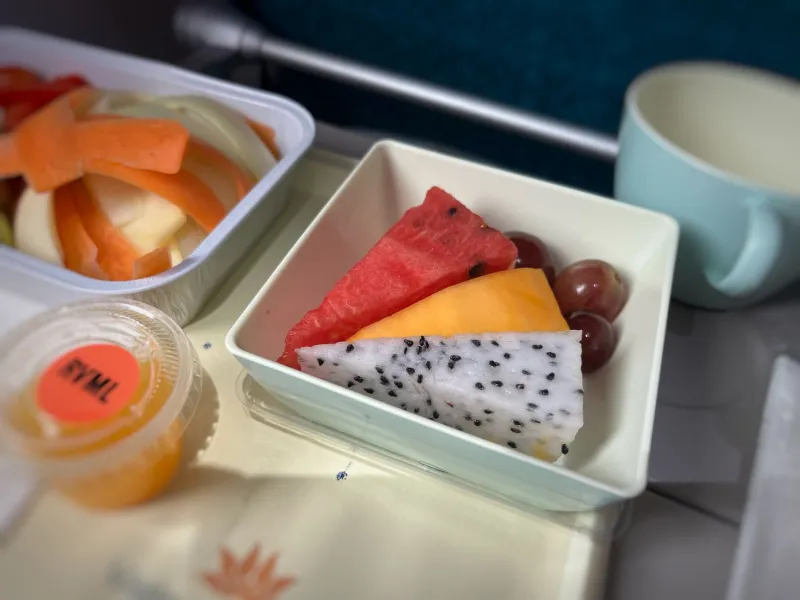
The Hindu Vegetarian Meal (HNML) and Asian Vegetarian Meal (AVML) are prepared by caterers who specialize in South Asian flavor profiles. Because these meals are made in smaller batches than the standard service, they often receive more deliberate spice calibration. Frequent travelers on the India-US route consistently report that these options deliver more pronounced flavor than their non-vegetarian counterparts.
The Jain Meal (VJML), which excludes root vegetables, is prepared with similar care and tends to feature bold, well-seasoned preparations that hold up reasonably well at cruising altitude.
For those who prefer non-vegetarian options, the Muslim Meal (MOML) is another strong choice on many carriers, as halal-certified preparation often involves distinct spice profiles that retain more character after reheating than milder, more generically seasoned dishes.
To request any of these, contact the airline directly after booking — either through the airline's website, by calling their customer service line, or by requesting it through your travel agent. Waiting until check-in is often too late.
Pre-Flight Preparation Strategies
Whatever the airline provides, there are things you can do before you even reach the gate to improve your in-flight dining experience.
Hydrate aggressively in the hours before departure. Well-hydrated olfactory tissues perform significantly better at altitude than dry ones. Avoiding alcohol and caffeine before boarding and during the early stages of the flight will help preserve nasal sensitivity.
Carry a small quantity of high-intensity flavor supplements. A few packets of your preferred hot sauce, a small container of lime pickle, or even a sachet of chaat masala tucked into your carry-on can serve as flavor amplifiers applied directly at the tray. These small additions can restore the sensory balance that altitude has stripped away.
Eat a light, flavorful meal at the airport before boarding. If your flight departs in the evening — a common departure window on the India-US route — eating a satisfying meal at the terminal allows you to approach the in-flight service with lower expectations and less hunger-driven disappointment. You can then treat the in-flight meal as a supplementary snack rather than a primary source of nutrition.
Avoid heavy, fatty foods in the hours before the flight. High-fat meals slow digestion, and the already-sluggish digestive processes that occur at altitude can make a heavy pre-flight meal feel oppressive by the time the cabin lights dim.
Timing Your Meal Service
On overnight India-US flights, the first meal service typically occurs shortly after departure, and a second lighter service is offered a few hours before landing. The first service, prepared closest to the catering facility's kitchen, is almost always the fresher and better-seasoned of the two. If you intend to sleep, it is worth staying awake for the first service and declining or minimizing the second.
Some travelers choose to skip the in-flight meal entirely on shorter legs of a connecting itinerary — eating well at the hub airport instead and sleeping through the meal service on the longer transoceanic segment. This is a legitimate strategy, particularly on connections where the catering quality is uncertain.
A Final Note on Perspective
In-flight food on the India-US route has improved considerably over the past decade. Airlines have invested in better catering partnerships, and the growing volume of South Asian travelers on this corridor has created genuine commercial incentive to get it right. The science of altitude-induced taste suppression remains an obstacle that no caterer can fully overcome, but the gap between what is possible at 35,000 feet and what airlines are actually delivering has narrowed.
With the right meal selection, a degree of pre-flight preparation, and a small kit of personal flavor enhancers, the long journey between India and America need not be a culinary endurance test. It can, with modest effort, be a reasonably satisfying one.